
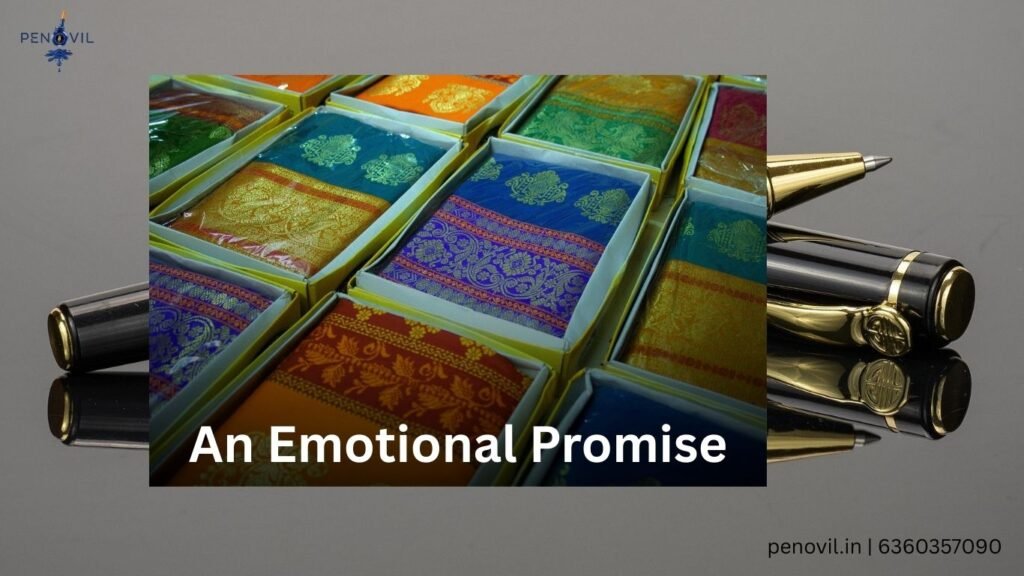
“Did You Know That My Website That Sounded Like My Father’s Speech?”
That’s what my co-passenger told me.
Sometimes, the most powerful business lessons don’t come from any book or seminar.
To me, it came from a stranger sitting next to me, my co-passenger on a flight to Chennai. Let’s call him Rohan. He was the head of a family-run textile business.
We got talking, and he shared a story that hit me right where it needed to.
It’s the perfect explanation for why so many websites, maybe even yours, just don’t connect.
Here’s what he said.
It was his family’s biggest bet.
After 25 years in textiles, he and his father had launched ‘Prakriti Silks’, sarees woven with heritage techniques, but for the modern Indian woman.
Their website was their digital showroom. They filled it with words they thought sounded… prestigious.
Words like “legacy looms,” “artisanal heritage,” and “curated textile narratives.” His father loved it. It sounded like the respectful, formal speech he’d give at a business conference.
But the carts stayed empty.
The wake-up call came from his sister-in-law, Priya, a corporate lawyer in Bangalore. She scanned the homepage one afternoon and said:
“Bhaiya, this feels like a museum plaque. It’s beautiful, but… who is it talking to?”
Rohan was defensive. “It’s talking about our quality! Our respect for the craft!”
“But is it talking to ME?” she asked.
“Look, when I shop for a saree for a wedding, I’m not looking for a ‘curated narrative.’ I’m thinking, ‘Will this drape easily in a crowded pandal? Will the blouse design work with my body? Can I wear it from the sangeet to the reception without feeling weighed down? Does it look both traditional and smart?”
Her words, Rohan told me, hit him like a monsoon shower.
They had written to feed their own ego, their vanity, to show the world how cultured they were. They’d forgotten to serve the aunty in Chennai, the working professional in Delhi, the young bride in Indore.
The common mistake made in most Indian businesses is talking at your audience instead of engaging with them in the conversation.
So Rohan did what he should have done first. He spent a week just listening. He read comments on saree haul videos.
He lurked in Facebook groups like ‘Saree Lovers of India.’
He discovered they weren’t asking for “artisanal heritage.”
They were asking, “Is this silk soft for sensitive skin?” Not “legacy looms,” but “Will the colour bleed on the first wash?”
They worried, “Will my conservative in-laws approve, but will I also feel stylish?”
That’s when he decided to bring in a professional.
The new copy threw everything out, including the vanity, completely.
Take a look:
Old Headline: “Reviving Heritage Looms for the Discerning Connoisseur.”
New Headline: “The Saree That Handles Your ‘Mama’s Function’ and Your ‘Office Party’ with Equal Grace.”
Old Copy: “Experience curated textile narratives.”
New Copy: “Lightweight Kanjeevarams that travel in your cabin bag, don’t need 100 pins, and get compliments from both your Dadi and your Instagram bestie.”
It spoke directly to real struggles: “No more sweating in heavy silks, our breathable weaves are made for Indian summers and packed hallways.”
It answered real questions: “Wash-care instructions so clear, your domestic help can follow them.”
They kept the heritage but framed it as a benefit for HER:
“The traditional ‘mukkalu’ border isn’t just for beauty—it adds strength where the pallu gets the most wear and tear.”
The result?
Rohan’s father was confused. “Beta, doesn’t it sound so… simple?”
But the customers weren’t.
Sales from the website tripled in two months. Their inbox flooded with messages saying, “Finally! A saree website that doesn’t sound like a textbook!”
One message made his father finally understand. A woman from Ahmedabad wrote:
“I felt like you were the friendly, knowledgeable aunty in the saree shop who knows exactly what I need, instead of the stern shop owner just listing the price.”
Rohan smiled as he finished the story.
Now his father proudly talks about the website: “Sab log bolrahehainki ‘aapki website baatkartihai.’” (Everyone is saying, ‘Your website talks to us.’)
“That,” Rohan told me, “is the only vanity metric that matters.”
As Rohan shared this, I wasn’t just nodding as a fellow traveller.
I was nodding as a content writer and storyteller.
Because this is the exact transformation I live for.
That shift from a “formal speech” to a “warm conversation” isn’t just about words.
It’s about shifting your gaze from your own reflection to your customer’s reality.
Your Indian customer isn’t browsing. They are solving a problem. They are navigating tradition and ambition, family expectations and personal style, crowded pandals and tight schedules.
Now, is your website giving a stiff, formal speech about your product or legacy?
Or is it having the warm, helpful conversation that makes her think, “Yes. They get me.”
Want to rewrite your website? This time, let’s make it talk.
If your website feels more like a “museum plaque” than a “knowledgeable aunty,” let’s change that. That’s the work I do. DM me and let’s start a conversation about your story.